
You own your PCB design files only if your contract says so. In the US and UK, whoever draws the board owns the copyright by default unless they're your employee. A freelancer or design firm keeps it until they sign a written assignment. Get 3 things in writing: an IP assignment, a list of native files and an NDA.
Updated November 10, 2026. By the Circuit Board Design engineering team. We're engineers, not lawyers. This is a practical guide, not legal advice, so have a lawyer in your country check your contract.
Three questions people mix up
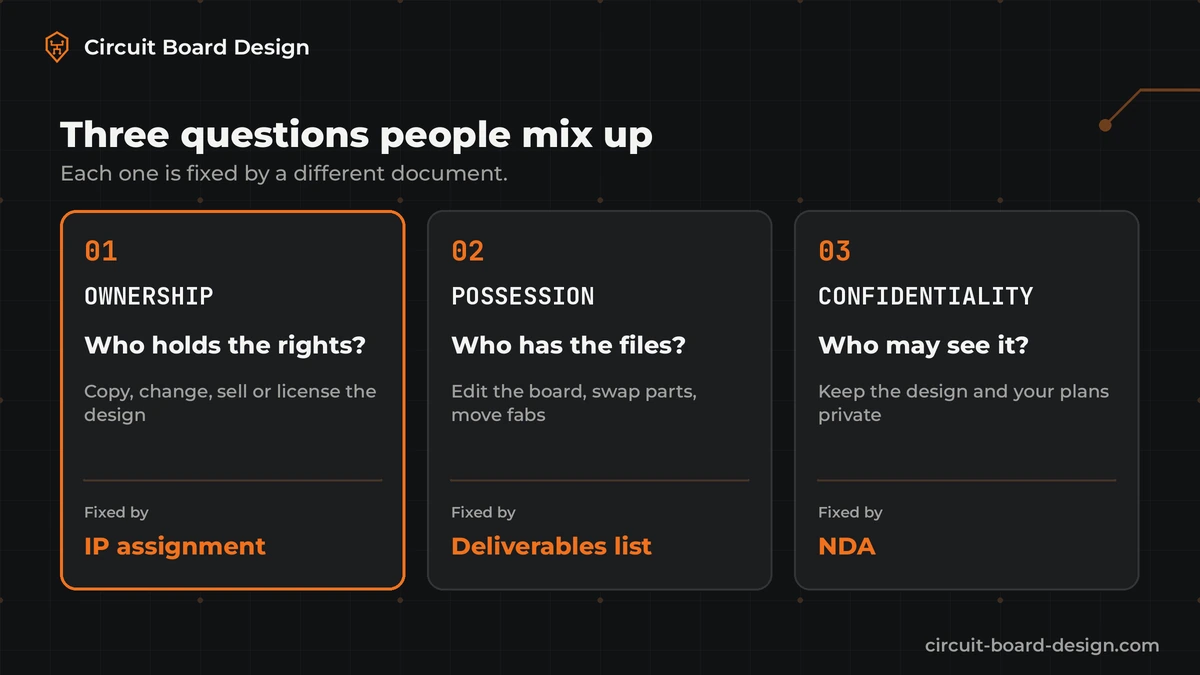
Founders often ask "who owns the design?" when they mean 3 different things. Each is fixed by a different document.
- Ownership (IP). Who holds the legal rights in the schematic, the layout and the drawings. This decides who can copy, change, sell or license the design. It's set by the contract and by copyright law.
- Possession (files). Who actually has the editable project. You can own every right in a board and still be stuck if you only got Gerbers. This is set by the deliverables list.
- Confidentiality (NDA). Who's allowed to see and talk about the design. An NDA keeps your files private. It doesn't move ownership to anyone.
Here's how each one can go wrong. Say a startup signs a 3-page NDA and assumes it owns the board. Or a founder pays 4 invoices in full, then finds the design firm kept the libraries. Or a team gets a full assignment on paper but only a zip of Gerbers and a schematic PDF. Each gap shows up at a bad moment. Usually it's when you switch fabs, or when an investor's due diligence list asks who owns the hardware and you can't point to one signed page.
What the law does when the contract is silent
This is where most founders get surprised. You can pay 100% of the invoice and still not own the design. Here's how 3 of the countries our clients work from handle it: the US, the UK and Germany.
United States
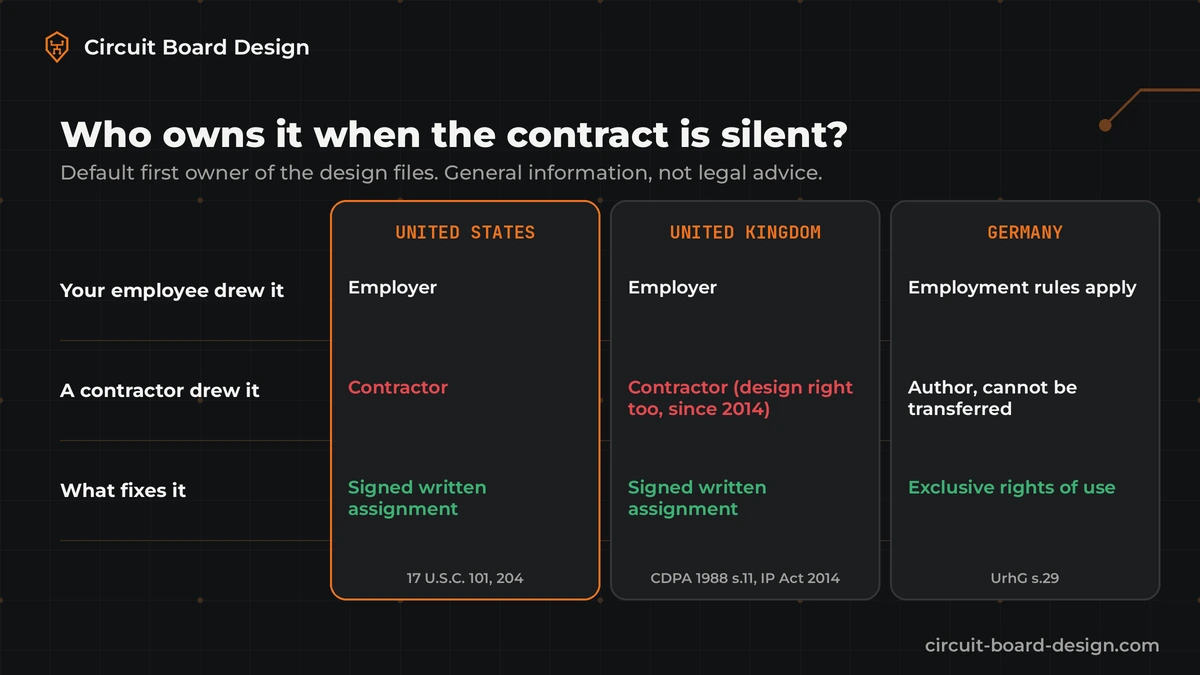
Under US copyright law, the author of a work owns it. There's one big exception called "work made for hire". The definition in 17 U.S.C. 101 covers two cases. Case 1 is work made by an employee within the scope of their job. Your employee's layout belongs to your company.
Case 2 is a commissioned work, and it's narrow. The work has to fall into 1 of 9 listed categories, such as a contribution to a collective work or a supplementary work, and both sides have to sign a written agreement that calls it a work made for hire. The Copyright Office's Circular 30 walks through the test. A PCB layout drawn by an outside contractor usually doesn't fit those categories well. That's why contracts normally add a plain assignment of rights as well, even when they also say "work for hire".
An assignment has its own rule, and you'll want to get it right. 17 U.S.C. 204 says a transfer of copyright ownership isn't valid unless it's in writing and signed by the owner of the rights, or their agent. A handshake, an email thread or a paid invoice won't do it.
United Kingdom
The UK starts in the same place. Section 11 of the Copyright, Designs and Patents Act 1988 says the author is the first owner of copyright. If an employee makes the work in the course of their job, the employer owns it unless they agree otherwise. A contractor isn't an employee, so a contractor keeps copyright unless it's assigned.
The UK also has unregistered design right, which can cover the shape of a product. Before 1 October 2014 the person who commissioned a design owned it. The Intellectual Property Act 2014 removed that rule, so the designer now owns a commissioned design unless the contract says otherwise. If you hired a UK designer on an old understanding of the law, read your contract again.
Germany
German law works differently again. Section 29 of the German Copyright Act says copyright itself can't be transferred, except on death. What a contract can do is grant rights of use. So German contracts grant you exclusive, unlimited rights to use, change and copy the design instead of "ownership". A US template pasted into a German deal may not say what you think.
| Who drew the board | US default | UK default | What fixes it |
|---|---|---|---|
| Your employee, as part of the job | Your company | Your company | Clear job scope and an employment IP clause |
| A freelancer | The freelancer | The freelancer | Signed written assignment in the contract |
| A design firm | The firm | The firm | Signed written assignment, which covers its staff and subcontractors |
| A marketplace gig | Read the platform terms | Read the platform terms | Check what the terms assign and when, then add your own if needed |
What copyright covers, and what it doesn't
Copyright protects the schematic drawings, the layout artwork and the files. It doesn't protect the idea behind your circuit. 17 U.S.C. 102(b) excludes any idea, procedure, process, system or method of operation. If your board contains a real invention, like a new sensing method, that's patent territory. Ask for your contract to assign inventions as well as copyright, and talk to a patent attorney before you show the design around.
Background IP: the part designers keep
Every experienced designer brings things that existed before you hired them. On a PCB job that means:
- Their verified footprint and symbol libraries, like a 0.5 mm pitch QFN footprint they've already built and checked on real boards.
- Reusable circuit blocks, like a reverse-polarity input stage or a USB-C section.
- Design rule templates, stackup files, Altium OutJob files and scripts.
A fair contract lets the designer keep these, because they use them for every client. That's normal. What you need is a licence to use them inside your design. It should be perpetual, royalty-free and cover your product and future versions of it. Without that licence, a footprint library baked into your project could in theory belong to someone else.
Watch for third-party material too. A circuit copied from a chip maker's reference design comes with that maker's terms. Open hardware blocks come with their own licence, such as CERN-OHL-S or CERN-OHL-P, and the strong version can require you to share your changes. Ask your designer to list anything like this in the release notes, so you're not surprised in 2 years.
Native files: ownership you can actually use
Rights in a design you can't edit aren't worth much. With Gerbers only, you can reorder the same board. You can't swap an end-of-life part or move 1 connector 2 mm without redrawing it.
So the contract should name the files, not only the rights. At minimum ask for:
- The native project in a named tool and version, such as Altium Designer 25, KiCad 9 or Cadence Allegro. In Altium that's the .PrjPcb project with its .SchDoc and .PcbDoc files. In KiCad it's the .kicad_pro, .kicad_sch and .kicad_pcb files. In Allegro it's the .brd board, usually with an OrCAD Capture .dsn schematic.
- Every symbol and footprint library the project uses, packed with the project.
- Fab and assembly outputs, the BOM with manufacturer part numbers and a STEP model.
- Design notes, DRC and ERC reports and release notes.
Our PCB design deliverables guide lists the full package and a 30-minute way to check it the day it arrives.
When files change hands
Many contracts say rights pass "on full payment". That's reasonable for both sides. Just know what happens if a project stops halfway. Say your board has 3 milestones: schematic, layout and release. You pay the first 2, then your funding round slips and you pause in week 6. If rights and files pass per milestone, you hold a signed-off schematic and a routed layout you can take anywhere. If they pass only at the end, you may hold nothing. Ask that the files for each paid milestone are handed over when that milestone is paid.
What a PCB design NDA should cover
An NDA protects secrecy. It doesn't make you the owner of anything. For a PCB project, check these 7 points.
- Signed before files move. Send nothing confidential until it's signed. If you already did, ask that the NDA covers information shared before the signing date.
- Mutual if needed. You share your product. The designer may share their methods. A mutual NDA is simple and common.
- What counts as confidential. Schematics, layouts, BOMs, firmware, test data and anything marked or obviously confidential.
- Who else may see it. The designer's staff and subcontractors should be bound by the same terms.
- How long it lasts. If your product sells for 5 years and the NDA runs for 2, the secrecy ends while you're still shipping.
- Portfolio and publicity. Can the designer show your board in a portfolio or name you as a client? Say yes or no in writing.
- Return or delete. What happens to your files at the end, and what the designer may keep for their records.
Contract checklist for founders
Use these 14 lines on any PCB design quote, including ours. If one's missing, ask before work starts. It's a 5-minute edit then and a hard talk later.
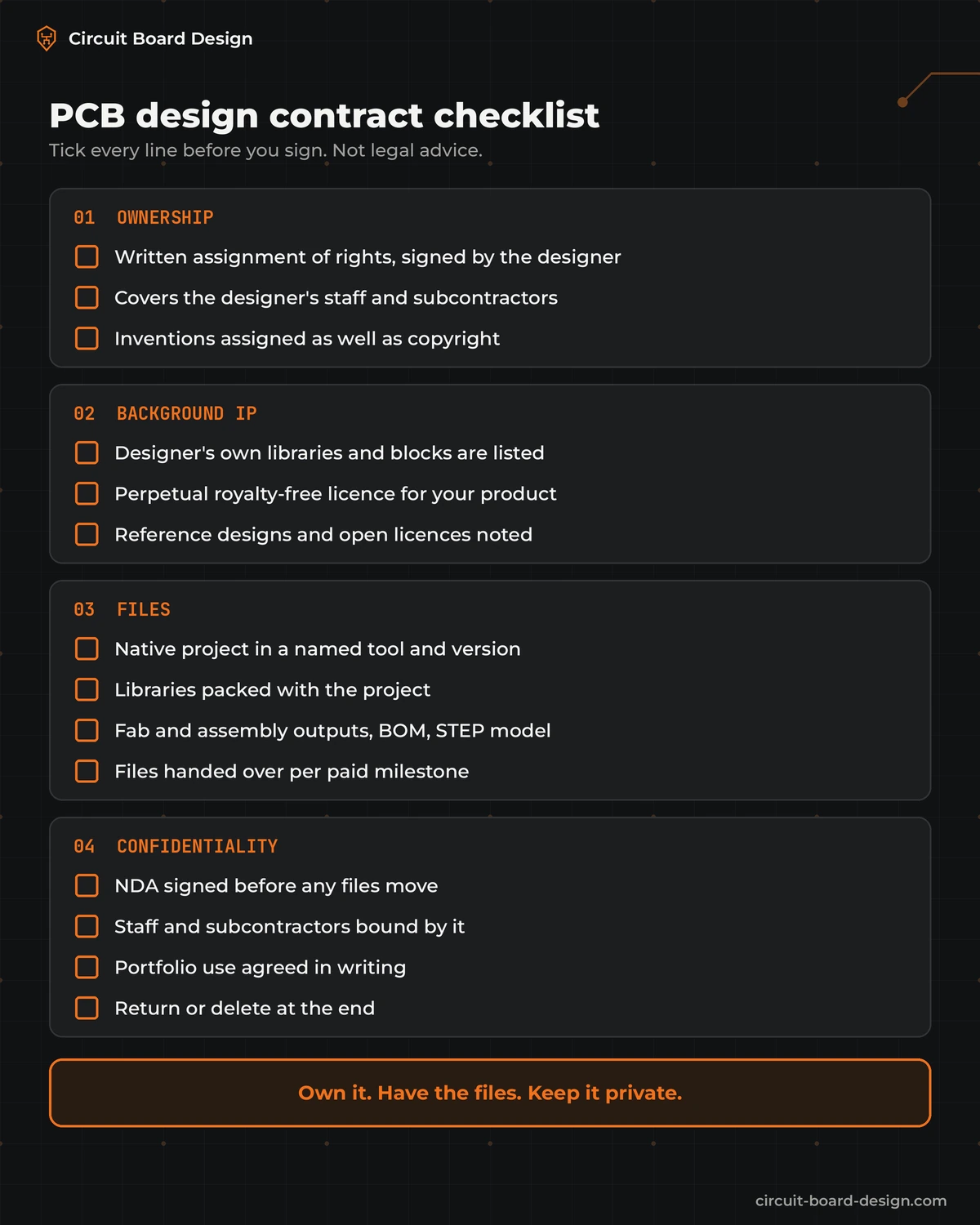
- Ownership: a written assignment of rights, signed by the designer.
- It covers the designer's staff and subcontractors.
- Inventions are assigned as well as copyright.
- Background IP: the designer's own libraries and blocks are listed.
- You get a perpetual royalty-free licence to use them in your product.
- Reference designs and open hardware licences are noted.
- Files: the native project in a named tool and version is a listed deliverable.
- Libraries are packed with the project.
- Fab and assembly outputs, the BOM and a STEP model are included.
- Files are handed over per paid milestone.
- Confidentiality: the NDA is signed before any files move.
- The designer's staff and subcontractors are bound by it.
- Portfolio use is agreed in writing.
- Your files are returned or deleted at the end.
Red flags in a quote or contract
Most come from old templates, not bad intent. Fix them anyway.
- "Client receives Gerber files." No mention of native files means you can reorder but not change the board.
- "Source files available for an extra fee." Fine if you know it up front. Agree on the fee and the file list in the quote.
- A licence instead of an assignment. "Client may use the design" isn't the same as "designer assigns all rights to client".
- Ownership only "on completion". If completion is never defined, a stalled project may never trigger the transfer.
- A one-way NDA that protects only the designer. Your files need protection too.
- No word on libraries. The project may open on your machine with missing parts.
Already have a board and no files?
It happens a lot. A freelancer moved on, a firm closed or the files died with a laptop. Here's what we'd do, in this order.
- Read what you signed. Look for any assignment wording and any list of deliverables. Emails that agreed the scope can help too.
- Ask in writing. A short, polite email asking for the native project and libraries works more often than you'd think. Designers usually keep archives.
- Get a signed assignment now. If the designer agrees, a short assignment signed today can cover work done in the past. A lawyer can draft one quickly.
- Rebuild if you must. A board can be redrawn from Gerbers, a schematic PDF and the physical board. It's slower and needs careful checking, but it gives you clean native files you control. If the old design was in EAGLE, our EAGLE migration guide covers the conversion route.
How we handle ownership at Circuit Board Design
Here's what our published terms of service say, so you can compare it with any other offer.
- On full payment, you own all rights, title and interest in the final deliverables we create for you.
- We keep our background IP. That's general knowledge, skills and libraries that aren't specific to your product.
- We may show a finished design in our portfolio unless an NDA prevents it. We'll sign an NDA before files change hands if you ask.
- Native files are handed back in your tool, whether that's Altium Designer, KiCad or Cadence, with the full fab and assembly package.
Need different terms, like milestone handover or your own assignment template? Tell us at the quote stage.
Frequently asked questions
Who owns a PCB design made by a freelancer?
In the US and the UK the freelancer owns the copyright by default, because they're not your employee. You become the owner when they sign a written assignment to you. Paying the invoice alone doesn't do it.
Does an NDA give me ownership of the design?
No. An NDA only controls who may see and share confidential information. Ownership comes from an assignment of rights in your design contract. You need both.
Is a PCB layout a work made for hire?
If your employee drew it as part of their job, yes. If a contractor drew it, often not. Under 17 U.S.C. 101 commissioned work only counts if it fits 1 of 9 categories and both sides sign. So contracts add a written assignment too.
Can a designer refuse to hand over native files?
If your contract doesn't list native files, the designer may only owe what it names, such as Gerbers. Put native files, libraries and the tool version in the deliverables list before work starts.
What is background IP in a PCB project?
It's what the designer owned before your project, like footprint libraries, circuit blocks, rule templates and scripts. Designers keep it. Your contract should give you a perpetual, royalty-free licence to use it in your product.
Do I own the design if I only paid part of the invoice?
Many contracts transfer rights only on full payment, so a project that stops halfway may leave you with nothing. Ask for files and rights to pass per paid milestone.
Not sure what you actually received?
Send us your board and the files you were given. Start with the free quick check and get checklist-level notes in 2 business days. We'll tell you what's missing from the handoff and what we'd fix in the design, under NDA if you prefer. If you need more, you get a fixed quote per board before any work starts.
Send your board for a free quick check
Starting a new board? See our PCB design services and PCB layout, or contact us for a fixed quote with the deliverables and ownership terms written in.
Sources
- 17 U.S.C. 101: definition of a work made for hire (Cornell LII)
- US Copyright Office, Circular 30: Works Made for Hire
- 17 U.S.C. 204: execution of transfers of copyright ownership (Cornell LII)
- 17 U.S.C. 102: subject matter of copyright (Cornell LII)
- Copyright, Designs and Patents Act 1988, section 11 (legislation.gov.uk)
- Intellectual Property Act 2014, section 2: commissioned designs (legislation.gov.uk)
- German Copyright Act (UrhG), section 29 (gesetze-im-internet.de)


